Sunday, January 11, 2015

Letters from the affected people – “Please learn our reality” --

The reality of Fukushima – Momoko Fukuoka’s voice                                      
 
Happy New Year!
I’ve already received many letters and pictures from people who had had been affected by the tsunami and the earthquake. They are in the fourth year living their “temporary life” with no future prospects, which is very sad and heart-wrenching.


This is the year’s first sunrise photographed near the temporary housing unit. It might not be clear to viewers, but this photo actually tells me a lot of things. I think of the sorrow of the families whose members had to be separated, especially during the New Year’s celebration. However, the New Year’s gorgeous sunrise seems to be telling us to hang in there. I would like to energize others just like the way this sunrise does. In order for me to do so, I would like to ask you for a helping hand. Thank you.
I would like to talk about people in Fukushima as usual. People sent me some letters and photos describing their never-changing reality. I have their permission to share them with you, so you can learn more about their lives.
 
 [A letter from Namie cho]
“This is the fourth New Year’s day that we spent outside our own hometown. I appreciate that you are still thinking of us even after four years. Since our normal life was taken away, we’ve been asking ourselves ‘who are we' and ‘where are we'. Then we realize that we are not able to do things that we used to take for granted.
I grew up in a fishing town called Ukedo. When I was a child, I used to love watching the ferries moving off the coast, and dream about riding one of them.  The whole seaport along with the entire community was washed away by the tsunami, leaving just seven fishing boats out of 130 intact. If the tsunami was the only disaster, we would have been able to fight back and stand on our own two feet again. But we had to face the invisible enemy, radiation. The news about the disaster-related deaths keeps on coming. We often see the recovery effort of Sanriku community in Miyagi prefecture on TV, but not in our own town. Luckily our house survived because it was built on a hill far enough from the coast. Sometimes we go home and spend a couple of hours cleaning our house. The road to our house is covered with weeds. Our land has many holes dug by boars and our house has new occupants, wild animals.  I heard the nuclear plant workers say that we cannot go back to our hometown of Namie for 30 years. However, the Japanese government wants to lift the evacuation order. I know that young people will never go back. They don’t want to live in a town with life-threatening issues. I cannot explain the whole range of our issues in a single letter. Let me stop here for now.”
“Our hometown is no longer the same. We have made an album from which I enclose some of the pictures. These may not be the kind of pictures that you want to see on a New Year’s day, but we would like you to know that this is our reality. These were actually taken two years ago and nothing has changed since. “


 “Central area in Namie cho: Huge rocks were moved by Tsunami and destroyed a car.”


 “More than 120 ships were brought onto high ground by the Tsunami. This is one of them. My house was washed away. My older brother and sister are missing, their remains are yet to be found.”


We still have piles of debirs all around. Do you see some trees on the left of this picture, that is the ocean behind them.
 
 [A gentleman who lost his wife in Tsunami and lives alone in a temporary housing unit]
“My house was washed away by the Tsunami. My wife died and her bones are with me here. I cannot place her bones in our family tomb because of the nuclear power plant. All I can do is to wipe her picture with a warm hand towel every morning. I am always with her remains. Even when I have meals, I always talk to her. This year we had our golden anniversary. Since my wife always wanted to go to Nikko for our anniversary, I took her picture and remains to Nikko. I saw many couples there, and it made me miss my wife very much.”
 [A lady who lives in a subsidized apartment in Iidate Village]
”People often suggest that I relocate elsewhere and stay away from radiation. But there is a reason why we cannot leave our hometown. The government does not buy out our land, or houses. Not only that, they also tell us that we have to take care of our property ourselves. We have to keep our house, rice paddies and vegetable fields in good shape, so that we can go back any time. That is why we cannot leave here. We need to stay in a commuting distance to our home. We have to maintain our property until we die.”
 [A surprising fact]
I was so surprised to learn that those who were affected by the disaster cannot leave their hometown, not only due to their homesickness but also because of the government’s policy expecting them to maintain their property themselves. Actually our government intends to have them go back to their homes despite its uninhabitable condition due to high radiation. They have been commuting to their homes where the radiation level allows them to stay only for four hours. They are doing this to maintain their rice paddies and vegetable fields. No one knows when they can go back to live permanently. It could be 30 years from now. Those people cannot contradict the government’s statements. The people are just enduring the current situation and the fear of radiation. I assume that the government’s intentions are to terminate the compensation payment for the evacuees, once they go back to their homes.
Don’t you think that the reality of Fukushima is too ugly, dirty and harsh? Don’t you think that we are not well-informed of the evacuees’ lives? We need to pay serious attention to Fukushima and learn about the people. I sincerely ask you for your heart-warming support for people in Fukushima. They are still in need of daily consumable goods such as food and clothing in addition to financial aid.
 
[My advice to regain the power for keep living] (No. 13)
Look for something positive in your day and when you wake up in the morning write down the things you like, or things that make you happy. You live, move, eat, and go to the bathroom regularly. You have the warmth of the sun, the wind, the rain, and the sound of crickets, etc. These are examples of some pieces of happiness. Once you write yours down, enjoy them as much as possible. You many not notice any of them at the beginning but, as you keep writing, you will see that we are surrounded by many happy things.
 
 [List of things that you can donate]
Blanket, hand and leg warmers, masks, adult diapers, toilet papers, detergent, water, rice, spices, dry foods, canned foods, snacks, tea, fruits, vegetables: these are very much needed. Many people are experiencing financial difficulty. I will let you know where to send those support goods.
Please contact me between 10:0017:30 (Japan time) at 011-81-80-5547-8675(mobile) or f.mom.1941@ezweb.ne.jp.
 If the line is busy, please try again later.
Thank you,
Momoko Fukushima


Saturday, December 20, 2014

To you, who never forget affected people

We only have a few days left till the end of this year. I have been thinking particularly about time lately, how time is really the accumulation of present moments. Each of them, each moment—each second—is a universal, heavenly gift. Perhaps people who can remain aware of this have a different way of spending time.


I would like to express my sincere appreciation for your heart-warming support for the victims of Fukushima, which you offered again this year. I am so grateful to each of you who gave kindness to others who were suffering.


Unfortunately, our society-at-large is already forgetting affected people. I’m surprised to find that there are many people who think: “Oh, I thought it was already resolved,” or, “neither the TV nor newspaper mention the affected people in Fukushima any more. So I thought they were fine now,” or, “the prime minister said that he would alleviate this issue, so I thought he already did,” etc. The public trusts the broadcasts and reports of major news outlets, so in order to hope that our culture remains aware of the plight of victims, we must also hope that the mainstream media responsibly covers the truth.


I’ve heard that both the Sennai and Takahama nuclear power plants have been given safety clearance according to new stricter regulations by Nuclear Regulatory Authority (NRA). On the other hand, volcanic activity has increased in Japan so that earthquakes have been reported on daily basis. “Japan has entered ‘a period of brisk seismic activity’.” (Prof. Satoshi Fujii of Kyoto University, Special Advisor to the Cabinet. Monthly magazine, “Voice,” April 3, 2014). Thus, I am completely puzzled—for the safety of our citizens, in such a period of “brisk seismic activity,” shouldn’t we continue the current “zero” operation status?


Meanwhile, our government is not paying attention to the affected people’s suffering at all. Moreover, they are intimidating and terrorizing those victims. They are not assisting them in leading any kind of normal life. We should spotlight this fact more. I want to hear many voices asking our government to take more appropriate relief measures.


[Voice of affected and now disenfranchised people – Why they were not able to vote]


“The voting rate among us was low. Of course it was low: we were not able to make it, although we wanted to. Those who evacuated outside the prefecture did not receive voting forms in time. It was not easy to obtain voting forms. Each affected person had to correspond with the municipal offices twice or more, which was very cumbersome for some. Many sick and elderly people are living in inconvenient temporary housing units in areas where it snows a lot; for them the roads were too slippery, and voting posts were too far away to reach. Authorities should have designated more convenient voting locations for residents in temporary housing units. The whole experience was very frustrating.”


[Restricted eligibility for recovery apartments]
Affected people report:
“Recovery housing is for those who are 75 years and older. I am still too young to move in.”
“Households with pets, even normal pets such as cats and dogs, are not eligible.”
“Those with loans or unpaid real-estate tax are not eligible.”


Affected people, having already lost their homes and family members to the tsunami, are still in tears and sorrow. The nuclear accident in Fukushima stole their houses, rendering them vacant and uninhabitable. Yet many victims must continue to make mortgage payments on those vacant houses. All while their families are torn apart, unable to live together in one space, living in unbearable, inhumane conditions—humid, cold, and cramped (apartments average four-and-a-half tatami mats in size). I see no rationality in this. Do you?


Japan should protect Fukushima victims under the Public Assistance Act. The government should take as its first priority the support of affected people, so that they can resume normal life. The victims of the nuclear power plant accident have lost their human rights: their right to a sanitary and safe living environment, to property ownership, to the obtaining of a residency card. Without a residency card, it is impossible to get a job. Younger generations of victims have left their homes in search of work, splitting families apart. Some of these young migrants are harassed by neighbors in their new towns. Without proper documents, some are unable to obtain financial backing to launch new businesses. Thus, affected people have been victimized many times over since the disaster. They continue to be victimized.


Resolving these issues must be our nation’s first priority.


I heard that affected families can stay in the temporary housing units until the end of March, 2016, which means that they have a year and three months left. They must decide what to do, where to live, by then. However, their reality is harsh. Some don’t have anywhere to go. Many elderly people here have been left alone, since younger generations live separately. With no savings for moving, inadequate financial support from the government, and insufficient decontamination of their houses, they have absolutely no money or capacity to renovate homes that, since the disaster, have been inhabited by mice and raccoons. Even if residents could return to their homes, it is impossible to live normal life there, in communities without stores, without shops, without medical facilities and staff.


I often hear the same sad news: an elderly person has gone to clean his or her house, and while there, committed suicide. They say, “I want to die in my own home rather than in the temporary housing unit.”


[Please give hope]


Ladies and gentlemen, please lend a hand to these affected people. They should not be left alone. Your continued support may bring them joy in the New Year.


I would like to take this opportunity to express my sincere appreciation for your support throughout this year. I hope for your good health and wish you a happy New Year.


With deepest appreciation and hope for your happiness.


[My advice for life] (12th)
May you have love instead of hate, forgiveness instead of fighting, truth instead of myth, hope instead of despair, pleasure instead of sorrow. May you have comfort and healing.  When you need love and peace, I am here for you.  


[Please donate!]
It is very cold. Blankets, hand warmers, masks, underpants for the elderly, toilet paper, detergent, water, rice, spices, dry foods, canned foods, snacks, tea, fruits, vegetables, etc., would be very much appreciated. We are also accepting donations.
We can provide more details about the donation process at your request.
<Contact> 10:00~17:30
Momoko Fukuoka (mobile) 080-5547-8675     (Please try again if the line is busy.)
                (e-mail) f.mom.1941@ezweb.ne.jp


Wednesday, December 10, 2014

By March 31, 2016....

The Lower House general election and national review of Supreme Court judges will happen on December 14th; I strongly hope that the results reflect the will of our citizens and will contribute to a better political climate.


Let me tell you what is going on in affected areas. Today, I’d like to raise awareness of affected people who still live in temporary housing units in this cold and soon-to-be much colder weather. Our government has asked them to return to their original homes by March 31, 2016.


[Severe Winter Weather Plagues Poorly-Constructed Temporary Housing]
I have been told that the temporary housing was constructed based on the assumption that the buildings would last two years at most. The building manuals were designed so that even construction companies that didn’t specialize in residential housing could build temporary units. Those built by major residential companies have been reliable, but the rest have been riddled by issues such as drafts coming in, humidity, floors that break easily, etc.


Some of the units are made with real lumber, some are prefabricated, and some have exposed iron frames, as though they were never finished. Some have no windows and no air circulation. Some have windows with no privacy. Thin walls between units mean everyone can hear everything. Thus, life in the temporary housing units is extremely stressful, and living conditions are inadequate. The units are also located in inconvenient places, such as the mountains, or on lower ground where vegetable and rice fields were once found—these former agricultural locations becomes pools of rainwater on rainy days. The humidity in cold weather freezes, and all the surfaces in the units become moldy. Meanwhile, some units get hot as saunas during the summer.


Thus, by chance of which unit they’ve been assigned, some residents are enduring unbearable living conditions. Moreover, their space is extremely limited: a room with four tatami mats—some with two rooms, depending on the number of family members. They’ve lived there for nearly four years. They’ll continue to do so until they find alternative places to live.


Here’s what I’ve heard from those residents:


“Between two of us, we have only two rooms: one with a three-and-a-half tatami mat space and one with a four-and-a-half tatami mat space. Other than that, we have a kitchenette, a toilet, a bathroom. That is it. There is no extra space to fit anything. We have cartons that contain all our stuff that we take in and out constantly. No dressers whatsoever. If we had a dresser, it would take up our sleeping space. This lifestyle affects our mental health. That is why some commit suicide. It is impossible to get used to this. We want to be released from this life. We are suffocated. Please help us! Can you believe it? Two more years like this, TWO MORE YEARS! SIX YEARS of endurance in total! It is impossible!”


It was a painful plea to hear. How can our government abandon people like this? Please help us resolve this issue as soon as possible!


The winter in Tohoku region comes early. Some temporary units experience cold weather right after “Obon” period (mid-August), when it has already snowed and frosted. Some residents cannot go out for shopping due to the weather. Some continuously wipe dripping water from the ceiling, due to the humidity and the frost. Of course, such conditions come hand-in-hand with mold. “We apply a plastic sheet to single-pane windows. We also spread aluminum foil on the floor throughout the winter to prevent heat loss,” said one resident.


Those who cannot go out, such as the elderly, the sick, and those with financial difficulties, always appreciate donations of food, underwear, blankets, and household goods such as toilet paper, detergent, and hand-warmers.  


[Deadline: April 2016]
Our government seems to have decided that affected people must return to their original homes by April 2016. This has accelerated TEPCO’s and the government’s efforts to dispose of affected people’s furniture and other household goods. TEPCO and our government are certainly willing to throw away furniture. However, the residences in areas where radiation is too high to sleep over need much more repair than furniture removal. Having been abandoned for nearly four years, the houses are full of mold, and have been totally ruined by mice, raccoons, bores, monkeys, snakes, and such. It is impossible to live in them. They need to be renovated. When it comes to such repair, however, I have never heard of TEPCO and our government offering any financial support to the residents. Some say “it is under negotiation.”


In the Kodaka and Taruha areas, radiation levels are still very high. I hear that the radiation is still leaking from the Fukushima Daiichi Nuclear Power Plant. I do not understand why our government can unilaterally decide, without paying any attention to residents’ exposure to radiation, that residents have to go back to their homes in two years.
Before anyone can return home, the condition of leaking radiation—its scale and areas of contamination—must be checked. We must publicize safety measures in order to minimize radiation exposure, making sure to do double and triple checks, with a real sense of responsibility for generations to come. This should be done beyond the barrier of political parties. This should be resolved as a crucial, once-in-a-century matter, and afforded every possible budgetary dollar. If we had done this from the beginning, we could have protected the lives of affected people. If we do it now, we can release them from their matchbox-like temporary housing units, and help them return to the way they used to live. We must keep human lives running as normally as possible.


Don’t you think this should have been our government’s first priority? If the recovery budget had been allocated to keep human life running as smoothly and as normally as possible for the victims of Fukushima, citizens would have been pleased. The reality is, however, citizens are enormously upset by the fact that the recovery budget has been used in a way that has nothing to do with protecting their normal life.


According to what I heard from residents, they have been told that they can stay at the temporary housing units until March 31, 2016, due to the target date of their return to their original homes, which is April 2016. I have also heard that some of the units will be demolished. So residents have to decide either to go back to their hometown, or relocate elsewhere. Meanwhile, construction of new “recovery apartments” is not making progress as planned. I assume that the government is planning to build enough of them by 2016 to house the displaced. They certainly should.


Here is the story of one affected family:


This woman is one of seven family members. Her father is sick and needs nursing care. Her husband holds a “radiation monitoring card” and works at the crippled nuclear power plant in order to make ends meet. Their daughter is mentally retarded. And they have three sons. She is in her 40s, with many medical issues, but working so hard to sustain her family. They have been using three temporary housing units in Aizu, where it snows a lot, as they are supporting each other. She told me, “We would like to live in the recovery apartments. There, each unit has three rooms with 5.5 tatami mats, a living room with three tatami mats, one closet, and a Japanese style room with a Japanese style closet space. Although it has no air-conditioning, curtains, cooktops, or ceiling lights, it sounds much better than the current temporary housing units. We can stretch our legs and it will make us feel like [we are] living as a family. For seven of us, one unit is not enough. So we may rent two units.”


She looked very happy as she explained this plan to me. However, I suggested that it might be better to rent a second-hand single family home, even if it was old. “You all can live under one roof and you’ll have more extra space. Before you decide to go with the flow of what the government presents, please carefully think of your family’s future.”


I understand that the affected people, especially those who are still in the temporary housing units, are eager to be released from their current, suffocating living conditions as soon as possible. They have been so constrained that their dream to be released from the current situation propels them to choose to live in “recovery apartments” whose units are tiny and inconvenient. This is one of my major concerns. The design of the recovery apartments should accommodate the needs of their future tenants.


[Please donate!]


It is getting very cold. Blankets, hand warmers, masks, underpants for the elderly, toilet paper, detergents, water, rice, spices, dry foods, canned foods, snacks, tea, fruits, vegetables, and such would be deeply appreciated. We are also accepting cash donations.


For more information please contact Momoko Fukuoka (Japanese language only)
(mobile) 080-5547-8675
Between 10:00~17:30 (please continue to call if the line is busy).
(e-mail): f.mom.1941@ezweb.ne.jp

Tuesday, November 11, 2014

Opening of the Jōban Expressway and purchase price to be applied for the land for the interim storage facility

[Resolution of the Fukushima Governor]


UCHIBORI Masao (50 years old) was elected Fukushima Governor on 26 October. Mr. Uchibori appealed to the public that he will:

  • ask the national government and TEPCO to take all necessary measures to bring the nuclear accident to the end and to decommission all ten nuclear power reactors located in the Fukushima Prefecture;
  • gather new industries in the coastal areas designated as evacuation zones, and stimulate employment and economic invigoration; and
  • dispel negative rumors and prejudice towards the food products and revitalize Fukushima’s agriculture, forestry and fisheries industry.


Further, the governor mentioned the following:
  • “I believe that engaging in the rebuilding of life of evacuees and reconstruction and revitalization of the evacuation zones will lead to a more empowered Fukushima Prefecture as a whole. I am determined to implement concrete measures so that I can move forward the reconstruction of Fukushima together with all of you.”
  • “Fukushima is still in the middle of the suffering of the nuclear accident. In order to truly put an end to this accident, we must say what we have to say to the government and to the utilities. I see it as a mission as the governor of Fukushima to appeal for a decommissioning of all nuclear reactors in Fukushima and for a society that does not rely on nuclear power. As a victim prefecture, I must do so both towards people within Japan and beyond.


[Opening of Jōban Expressway and radiation air dose rates]


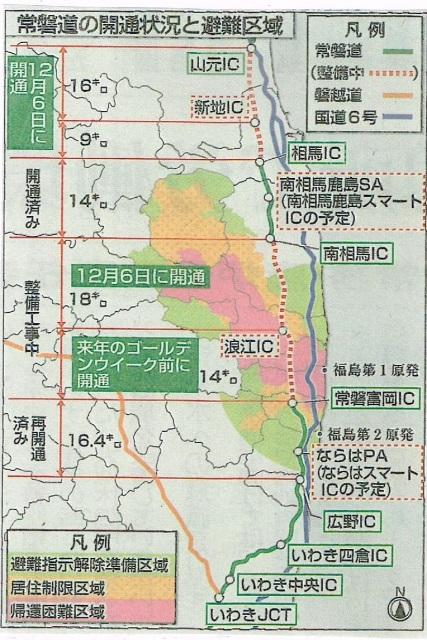
An article titled “Prime Minister declares the partial opening of Jōban Expressway (Namie Town-Minamisouma) (Souma-Yamamoto) on 6 December” on Fukushima Minyu, issued on 1 November 2014, details the status regarding the Jōban Expressway in a map that also shows different evacuation zones.
C:\Users\kkmiyai\Desktop\福島写真\常磐道開通状況.jpeg

Currently, traffic is allowed for only between Minamisoma and Souma among the sections between Tomioka Interchange (IC) and Yamamoto IC on the Jōban Expressway, which includes Jōban tomioka, Namie, Minamisouma, Souma, and Yamamoto. The part between Jōbantomioka and Namie, which was announced to be open by Golden Week Holiday 2015 (end of April to early May), is located in the west of the Fukushima Daiichi Nuclear Power Plant, and is designated as an Area where it is expected that the residents have difficulties in returning for a long time. The road between Namie and Minamisouma, which will resume traffic on 6 December, belongs to the areas in which the residents are not permitted to live and areas to which evacuation orders are ready to be lifted. There are some parts of this road segment where high radiation dose rates are still recorded. Even for the parts where traffic already resumed, there have been testimonies of aid workers expressing their fear because “the dosimeter beeped repeatedly”. In the area near Ottazawa, Okuma Town, the host town of the Fukushima Daiichi, the radiation dose rate allegedly reached 13.52 μS/h even with the car doors closed and air conditioning set to internal air circulation only (Even within the areas where it is expected that the residents have difficulties in returning for a long time, there are areas where traffic is allowed either freely or under certain conditions).


On 12 October 2014, the Ministry of the Environment released the results of the follow-up study of their model decontamination project. Below are the radiation air dose rates between June and July 2014 published by the Ministry of the Environment. (Measured by Japan Atomic Energy Agency [JAEA]; units used are μS/h)
  • Ottazawa, Okuma Town5.19-45.1 (area average 13.8)
  • Near Okuma Town Hall1.02-5.26 (Id. 2.82)
  • Tsushima, Namie Town1.13-3.90 (Id. 2.21)
  • Gogendo, Namie Town0.69-1.70 (Id. 1.17)
  • Yorunomori park, Tomioka Town1.07-3.16 (Id. 2.20)
  • Daini Junior High School, Tomioka Town0.38-1.50 (Id. 0.71)
  • Kusano, Iitate Village0.45-2.06 (Id. 0.90)
  • Special Nursing Home Iitate Home, Building No.10.41-1.97 (Id. 1.06)
  • Kainosaka, Kawauchi Village0.54-2.13 (Id. 0.89)
  • Near Katsurao Village Office0.26-0.85 (Id. 0.48)
  • Near Kanabusa Elementary School, Minamisouma City0.14-0.73 (Id. 0.42)
  • Industrial complex, Naraha Town0.10-0.20 (Id. 0.16)


The data shown above are published by the Ministry of the Environment (http://josen.env.go.jp/en/; http://josen.env.go.jp/area/model_after.html).
However, according to the disaster victims, the figures vary from place to place, and figures 20 to 30 times higher can be recorded in Naraha. Similarly, the figures are significantly higher in the mountain side of Miyakoji in Katsurao Village. Even in Minamisouma, Odaka District measures as high as Iitate village, and the dose rates are so high that people are unable to stay.
Personally, I see a clear disparity between the dose rates published by the government, and what local residents are finding. The local people say: “the rates a much higher than the what are published on the newspaper”, “it seems appropriate to think that the real figures are at least three times higher (than the official figures)”. There some people who feel that they “do not know what to believe”.


[Purchasing price to be applied for the land for the interim storage facility]


According to the disaster victims, the purchase prices (JPY/ m2) for the land planned to be used for interim storage facilities (Futaba Town and Okuma Town) are as below (
  • Dwelling land adjacent to the town road(s)
Agricultural settlement—Futaba, Okuma 4,500
Industrial complex—Futaba 3,300; Northern side of Okuma 2,950, others 3,150
Residential area—Futaba 5,950; Okuma 5,250 and 6,200
Inland area—Okuma 2,800 and 3,350
  • Agricultural land
Rice field North—Futaba and Okuma 1,200
Rice field South—Futaba 1150; Okuma 1,200
Farmland—Futaba and Okuma 1,150
Mountain forest—Futaba and Okuma 520


They must come as a surprise. Land prices are usually much higher. Why must these disaster-affected areas be priced so inexpensive? With such prices, it feels so unrealistic to expect victims to rebuild their life.


For your reference, I indicate below official land prices from some other areas of Japan (JPY/m2 as of 2014; Data from Land Price Data http//www.tochidai.info).
  • Gunma Prefecture —average 44,850; dwelling land 34,119 and commercial land 61,044
  • Matsudo City, Chiba Prefecture—average 173,959; dwelling land 133,048; commercial land 335,826
  • Saitama Prefecture—average 137,732; dwelling land 113,957; commercial land 271,312
  • Okayama Prefecture—average 52,385; dwelling land 36,834; commercial land 96,963
  • Akita Prefecture—average 27,084; dwelling land 17,716; commercial land 32,032
  • Niigata Prefecture—average 47,171; dwelling land 31,902; commercial land 77,152
  • Fukushima Prefecture—average 29,970; dwelling land 25,219; commercial land 50017
(Koriyama City 53,194; Fukushima City 45,920; Iwaki City 35,601; Aizu 35,330; Minamisouma 25,540; Nihonmatsu 22,224; Miharu Town 21,723; Tamura City 12,457)


Governor Uchibori spoke about “saying what we have to say to the government and TEPCO”. However, why is the government shifting all blame to TEPCO and the governor of Fukushima,  and not actively bearing responsibility themselves?


Why is the government unable to say that “the Abe Cabinet will take responsibility for the nuclear accident, and the Abe Cabinet will solve the problems” or that “the government will protect Japanese citizens’ lives”.


It has become very rare to hear the Abe Prime Minister speak about the measures for the Fukushima victims.


Also because of the decreased media reports on Fukushima, many people may be assuming that the issues of Fukushima have been solved. I sincerely wish that you do not forget about the fact that the reality has become even harsher than before.


The victims in Fukushima are still in need of relief supplies (food products, commodities and monetary donation). We thank you very much in advance for your support.


[My advice for life] (10th)
Our mind gets affected by things that surround us. Every day on TV shows, we watch scenes with murders, sexual stimulus or violence. With extensive exposure to such stimulating scenes, our heart and mind get exhausted. Ironically, we also get addicted to stimulations. If we find ourselves not able to stand silence—a soundless world—anymore, it may be an indication that our heart and mind have become negatively affected by these unwanted simulations. It may be good to sometimes turn off the TV, and listen to the singings of insects or sounds of falling rain. You may recall the treasures that you had long forgotten. You may also rediscover a totally different kind of happiness and sense of fulfillment.


[Please donate!]
Foods products, such as water, rice and spices, as well as daily commodities would be very much appreciated.
<Contact> 10:00~17:30
Momoko Fukuoka (mobile) 080-5547-8675(Please try again if the line is busy.)
(e-mail) f.mom.1941@ezweb.ne.jp