Tuesday, November 11, 2014

Opening of the Jōban Expressway and purchase price to be applied for the land for the interim storage facility

[Resolution of the Fukushima Governor]


UCHIBORI Masao (50 years old) was elected Fukushima Governor on 26 October. Mr. Uchibori appealed to the public that he will:

  • ask the national government and TEPCO to take all necessary measures to bring the nuclear accident to the end and to decommission all ten nuclear power reactors located in the Fukushima Prefecture;
  • gather new industries in the coastal areas designated as evacuation zones, and stimulate employment and economic invigoration; and
  • dispel negative rumors and prejudice towards the food products and revitalize Fukushima’s agriculture, forestry and fisheries industry.


Further, the governor mentioned the following:
  • “I believe that engaging in the rebuilding of life of evacuees and reconstruction and revitalization of the evacuation zones will lead to a more empowered Fukushima Prefecture as a whole. I am determined to implement concrete measures so that I can move forward the reconstruction of Fukushima together with all of you.”
  • “Fukushima is still in the middle of the suffering of the nuclear accident. In order to truly put an end to this accident, we must say what we have to say to the government and to the utilities. I see it as a mission as the governor of Fukushima to appeal for a decommissioning of all nuclear reactors in Fukushima and for a society that does not rely on nuclear power. As a victim prefecture, I must do so both towards people within Japan and beyond.


[Opening of Jōban Expressway and radiation air dose rates]


An article titled “Prime Minister declares the partial opening of Jōban Expressway (Namie Town-Minamisouma) (Souma-Yamamoto) on 6 December” on Fukushima Minyu, issued on 1 November 2014, details the status regarding the Jōban Expressway in a map that also shows different evacuation zones.
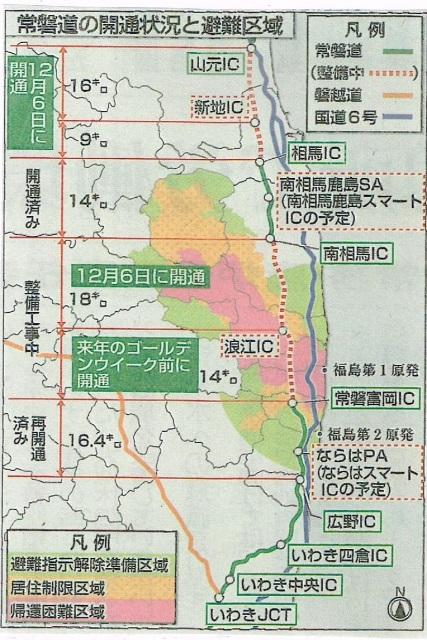
C:\Users\kkmiyai\Desktop\福島写真\常磐道開通状況.jpeg

Currently, traffic is allowed for only between Minamisoma and Souma among the sections between Tomioka Interchange (IC) and Yamamoto IC on the Jōban Expressway, which includes Jōban tomioka, Namie, Minamisouma, Souma, and Yamamoto. The part between Jōbantomioka and Namie, which was announced to be open by Golden Week Holiday 2015 (end of April to early May), is located in the west of the Fukushima Daiichi Nuclear Power Plant, and is designated as an Area where it is expected that the residents have difficulties in returning for a long time. The road between Namie and Minamisouma, which will resume traffic on 6 December, belongs to the areas in which the residents are not permitted to live and areas to which evacuation orders are ready to be lifted. There are some parts of this road segment where high radiation dose rates are still recorded. Even for the parts where traffic already resumed, there have been testimonies of aid workers expressing their fear because “the dosimeter beeped repeatedly”. In the area near Ottazawa, Okuma Town, the host town of the Fukushima Daiichi, the radiation dose rate allegedly reached 13.52 μS/h even with the car doors closed and air conditioning set to internal air circulation only (Even within the areas where it is expected that the residents have difficulties in returning for a long time, there are areas where traffic is allowed either freely or under certain conditions).


On 12 October 2014, the Ministry of the Environment released the results of the follow-up study of their model decontamination project. Below are the radiation air dose rates between June and July 2014 published by the Ministry of the Environment. (Measured by Japan Atomic Energy Agency [JAEA]; units used are μS/h)
  • Ottazawa, Okuma Town5.19-45.1 (area average 13.8)
  • Near Okuma Town Hall1.02-5.26 (Id. 2.82)
  • Tsushima, Namie Town1.13-3.90 (Id. 2.21)
  • Gogendo, Namie Town0.69-1.70 (Id. 1.17)
  • Yorunomori park, Tomioka Town1.07-3.16 (Id. 2.20)
  • Daini Junior High School, Tomioka Town0.38-1.50 (Id. 0.71)
  • Kusano, Iitate Village0.45-2.06 (Id. 0.90)
  • Special Nursing Home Iitate Home, Building No.10.41-1.97 (Id. 1.06)
  • Kainosaka, Kawauchi Village0.54-2.13 (Id. 0.89)
  • Near Katsurao Village Office0.26-0.85 (Id. 0.48)
  • Near Kanabusa Elementary School, Minamisouma City0.14-0.73 (Id. 0.42)
  • Industrial complex, Naraha Town0.10-0.20 (Id. 0.16)


The data shown above are published by the Ministry of the Environment (http://josen.env.go.jp/en/; http://josen.env.go.jp/area/model_after.html).
However, according to the disaster victims, the figures vary from place to place, and figures 20 to 30 times higher can be recorded in Naraha. Similarly, the figures are significantly higher in the mountain side of Miyakoji in Katsurao Village. Even in Minamisouma, Odaka District measures as high as Iitate village, and the dose rates are so high that people are unable to stay.
Personally, I see a clear disparity between the dose rates published by the government, and what local residents are finding. The local people say: “the rates a much higher than the what are published on the newspaper”, “it seems appropriate to think that the real figures are at least three times higher (than the official figures)”. There some people who feel that they “do not know what to believe”.


[Purchasing price to be applied for the land for the interim storage facility]


According to the disaster victims, the purchase prices (JPY/ m2) for the land planned to be used for interim storage facilities (Futaba Town and Okuma Town) are as below (
  • Dwelling land adjacent to the town road(s)
Agricultural settlement—Futaba, Okuma 4,500
Industrial complex—Futaba 3,300; Northern side of Okuma 2,950, others 3,150
Residential area—Futaba 5,950; Okuma 5,250 and 6,200
Inland area—Okuma 2,800 and 3,350
  • Agricultural land
Rice field North—Futaba and Okuma 1,200
Rice field South—Futaba 1150; Okuma 1,200
Farmland—Futaba and Okuma 1,150
Mountain forest—Futaba and Okuma 520


They must come as a surprise. Land prices are usually much higher. Why must these disaster-affected areas be priced so inexpensive? With such prices, it feels so unrealistic to expect victims to rebuild their life.


For your reference, I indicate below official land prices from some other areas of Japan (JPY/m2 as of 2014; Data from Land Price Data http//www.tochidai.info).
  • Gunma Prefecture —average 44,850; dwelling land 34,119 and commercial land 61,044
  • Matsudo City, Chiba Prefecture—average 173,959; dwelling land 133,048; commercial land 335,826
  • Saitama Prefecture—average 137,732; dwelling land 113,957; commercial land 271,312
  • Okayama Prefecture—average 52,385; dwelling land 36,834; commercial land 96,963
  • Akita Prefecture—average 27,084; dwelling land 17,716; commercial land 32,032
  • Niigata Prefecture—average 47,171; dwelling land 31,902; commercial land 77,152
  • Fukushima Prefecture—average 29,970; dwelling land 25,219; commercial land 50017
(Koriyama City 53,194; Fukushima City 45,920; Iwaki City 35,601; Aizu 35,330; Minamisouma 25,540; Nihonmatsu 22,224; Miharu Town 21,723; Tamura City 12,457)


Governor Uchibori spoke about “saying what we have to say to the government and TEPCO”. However, why is the government shifting all blame to TEPCO and the governor of Fukushima,  and not actively bearing responsibility themselves?


Why is the government unable to say that “the Abe Cabinet will take responsibility for the nuclear accident, and the Abe Cabinet will solve the problems” or that “the government will protect Japanese citizens’ lives”.


It has become very rare to hear the Abe Prime Minister speak about the measures for the Fukushima victims.


Also because of the decreased media reports on Fukushima, many people may be assuming that the issues of Fukushima have been solved. I sincerely wish that you do not forget about the fact that the reality has become even harsher than before.


The victims in Fukushima are still in need of relief supplies (food products, commodities and monetary donation). We thank you very much in advance for your support.


[My advice for life] (10th)
Our mind gets affected by things that surround us. Every day on TV shows, we watch scenes with murders, sexual stimulus or violence. With extensive exposure to such stimulating scenes, our heart and mind get exhausted. Ironically, we also get addicted to stimulations. If we find ourselves not able to stand silence—a soundless world—anymore, it may be an indication that our heart and mind have become negatively affected by these unwanted simulations. It may be good to sometimes turn off the TV, and listen to the singings of insects or sounds of falling rain. You may recall the treasures that you had long forgotten. You may also rediscover a totally different kind of happiness and sense of fulfillment.


[Please donate!]
Foods products, such as water, rice and spices, as well as daily commodities would be very much appreciated.
<Contact> 10:00~17:30
Momoko Fukuoka (mobile) 080-5547-8675(Please try again if the line is busy.)
(e-mail) f.mom.1941@ezweb.ne.jp

Sunday, October 12, 2014

Current Situation in Affected Areas and Warning on Radiation Disaster

I want to express my deepest sympathy for those suffering from the immense damage of the season’s eighth typhoon. I sincerely pray for their quick recovery. 

Now, please let me update you on the current situation in Fukushima, as well as give voice to some of those raising an alert over the radiation-contaminated soil in Japan.


Voice of affected people


Voices from Miyakoji

“It’s been more than three years since the disaster. In 2011, I went through enormous fear and anxiety. Now, more than three years later, local residents are suffering more worry than ever.

After two or three years, we still had hope and trust that our country would give us a way to survive, take appropriate measures, and demonstrate a spirit of cooperation, a will to work toward reconstruction.

But our country has abandoned us. They do not listen to anything we say. None of our government, town, or parliament are responding to our concerns. Not a single person can tell us what levels of radiation are safe, or dangerous. When we asked, “Is it safe to be exposed to less than 0.23 μSv/h?” they said, ‘We cannot say anything about it.’ Even our city officials and ward mayors are not able to clarify it properly. Our anxiety is reaching a breaking point.


In one room in my home, in fact, the level of exposure is 0.3-0.4 μSv/h. We are exposed to 0.56 μSv/h of radiation in our garden, and 1.8 μSv/h of radiation in a cedar forest in our backyard. Although these areas were decontaminated and previously had lower levels of radiation, the levels are rising.

And even with all this, we are pushed to go back to our hometown. I have heard that temporary housing will be closed in March 2016. We don’t sleep at home. We come back to the temporary housing. Since we cannot abandon our fields, we visit home and work there four to five hours per day.

Our nation’s government used to tell us that we would be safe as long as we were exposed to less than 1μSv/h per year. Now they say that we’ll be safe exposed to the extent of 20μSv/h. Why nobody seriously tackles the issue of radiation contamination? We are frustrated. Our voices are not being taken seriously.


I was told, ‘When are you going back to your home? I assume you already know the evacuation order has been canceled.’ There is nobody who truly understands our struggles.

Even in the same Miyakoji municipality, the level of radiation contamination varies from place to place. This situation creates emotional divides between the residents. We are not unified. People no longer gather even if we call for a meeting. We are no longer able to have a festival.”
 
“In temporary housing, we have one 4-tatami mat room for one to two people, two 4.5-tatami mat rooms for three to four people, and three rooms for families of more than five (one 6-tatami mat room, and two 4.5-tatami mat rooms), Each room has only space for bedding. There is no furniture and there are no closets.”


A voice from Ookuma


“Families and friends were separated, with no choice. Do you understand how it feels to lose every single thing, including our hometown? Do you know how hard it is? Don't even joke that you are motivated by money. It is unbelievable how many unsympathetic people are working as councilors. There are 800 people in the Congress. Why don’t they take contaminated wrecks into each of their houses? I sincerely hope they understand our feelings. I would like to say to the affected people: ‘Enough graciousness. How long are you going to bear living in temporary housing? How long are you planning on complying with this nation? Why don’t we stand up? Enough.’”


A voice from Namie

“It took two hours each way to visit my home in Namie. It was not inhabitable any more. I disposed of all my possessions. I put the combustible things outside of my house. Since it has not been decided how to dispose of non-burnable things, like plates and utensils, I kept them inside of my house. My house was completely covered with mold. Each of the recovery housing units can accommodate twenty families. But we don’t know how long it will take until we can move, since senior citizens and families with small children are prioritized.”


Warning of Danger


Dr. Masamichi Nishio, Director of the Hokkaido Cancer Center

“Please wake up, every one! Since shortly after the nuclear accident caused by the Great East Japan Earthquake, I’ve been saying that it is far better to tell the truth only once, rather than saying, ‘Go for it, Japan!’ a million times. Our government ought to check radiation strictly, buy contaminated land and houses to turn them into public land, and support the victims in order for them to be able to live comfortably on new land.


I’d say Japanese people are ‘the kindest people’ in the world. There is a word called ‘Unomido’ in Japanese, which means how much people accept things without questioning. I’d say that around 70 percent of Japanese people accept without questioning what schools and textbooks teach and what media shows. They don’t know how to develop a critical view.”

(source: “We Need No Nuclear Power for the Lives of Our Future Generations” The fifth edition <PKO Act “Zassoku” wo hiromeru kai, 2014, April 21>)

“The Truth of Radiation Health Problem” by Masamichi Nishio (Published by Jumposha, 2014, April)

 
Dr. Nishio’s lecture and opinion on nose bleeding and radiation health problems are available online.

Atomic Bomb Survivor in Hiroshima, Dr. Shuntaro Hida

“Children are vulnerable to radiation. The rapidly dividing cells are the most vulnerable. They are far more vulnerable than adults; therefore it is extremely important not to let them be exposed to radiation.


Nevertheless, our country’s government says that children are safe to be exposed to less than 20 μSv/h. How do they take responsibility for that? They have been acting recklessly, saying ‘It’s alright,’ although radiation has been falling on us every day.


There must be a forced evacuation order for all children in elementary schools and junior high schools in Fukushima. This must be made to happen; this must be implemented in reality.”
 

(“We need no nuclear power for the lives of our future generations” The third edition <PKO Act “Zassoku” wo hiromeru kai, 2011, December 8>), “The Threat of Internal Exposure” by Shuntaro Hida (Chikuma Shinsho, 2005), “Shuntaro Hida’s ‘Something that I have to tell you now’: for your own survival against internal exposure” (published by Nippon Hyoronsha, 2013), “Myth that leads to death – The nation’s cover-up of low-dose radiation”, (PKO Act “Zassoku” wo hiromeru kai, 2008, 3rd edition), Translation “Impact of Radiation – Low-dose radiation’s impact on human body. Guidance for the medical treatment of radiation survivors—“(Do, 1991), others.


Other references

Shinshu Hida “A Collection of Photographs / Real Fukushima”December, 2013 http://www.hida-fukushima.com/index.html#shashin

”Collection of References for appropriate approach to IAEA”Fukushima Action Project, November 24, 2012 fukushimaactionproject@gmail.com

Web Series “Letter from Fukushima by Yoshiyuki Inoue” (“Tokyo Shimbun TOKYO Web http://www.tokyo-np.co.jp/article/feature/tohokujisin/fukushima_report/

Film “A2-B-C”A documentary film by Ian Thomas Ash reporting on children in Fukushima. The title is a category of the thyroid test results http://www.a2-b-c.com/


Please support affected people


The following items are needed:

Under ware, blankets, disposable diapers in adult sizes, sanitary pads, household expendable supplies, water, spices, rice, food in general

Thank you for your support!


Contact10:0017:30Please try again if the line is busy. Japanese only
Momoko Fukuoka     (Mobile011-81-80-5547-8675  f.mom.1941@ezweb.ne.jp

Tuesday, September 23, 2014

Before the Fourth Winter, Disaster Survivors Choose Suicide


We are about to enter the fourth winter at the Fukushima disaster area. Residents of temporary housing near the dam in Miharu report: "In August after the Obon, it is already cold. We are beginning to need winter blankets, underwear, and masks."

October is around the corner. How cold the steel-framed, temporary construction of relief housing can be.
Let me tell you about the current situation of the disaster survivors of Fukushima.

[Voices of the Disaster Survivors]

In Narahamachi, a 92-year-old female living alone says: "Everybody is saying no, no, no. After losing her husband in April, an 87-year-old friend hanged herself in the nearby mountains.
 
“Ten TEPCO people came and took everything, including my cupboard, pots, and dishes, and treated them like over-sized garbage. Everything is gone except the clothing that I use. It's painful. It is worse than war. Everything is empty. I wish I could show you. TEPCO executives came and said quietly, ‘Radiation will not disappear. It will take 30, 40 years.’”

But the government has lifted its restrictions on inhabitants’ return to contaminated areas.

Also in Narahamachi, a 53-year-old male living alone says: "There was an 80-year-old grandmother who jumped to her death. She ran and threw herself off a 30-meter cliff. An 80-year-old grandmother! She said, ‘I cannot live in temporary housing.’
 
“A person in his forties also hanged himself on a doorknob, with a rope. So many suicides.

“Even in the same building, the disaster survivors no longer talk to each other. Everybody has changed. Before, they used to reach out to one another and have tea, but they no longer care about one another. Everybody has become depressed. Locals think of us as trash. They think we disaster survivors are living off the money from the power company. Since we evacuated, real estate prices have gone up. The apartments are gone, and hospitals have become crowded. So I can understand how the locals feel."

In Minamisouma, a 70-year-old male living with his wife says: “I was swept away by the tsunami, but I was 33 kilometers away from the nuclear plant. TEPCO will pay the compensation up to a 30-kilometer radius, but not beyond 30 kilometers. Even though we all live in Minamisouma. They say it has nothing to do with TEPCO. A one-time payment was given for tsunami survivors. The government should consider the survivors beyond the nuclear plant, because our very livelihood is in danger.
 
"The Prime Minister and other politicians go to the nuclear plant, but nobody comes to our temporary housing. No one. At the time of the accident, no aid workers or volunteers came, because they were afraid of the radiation. The government told them not to go. But the government did not object to us living there. And we really had no relief supplies. That was merciless. Fukushima really had no aid."

 Even now, victims are still in need of food and basic items for daily living.

 "Next time they put us into temporary housing, they should divide us according to villages. Like now, one temporary construction has different people from different villages, which makes it hard to work together. Each village has different festivals. If people are from same village, they know each other's faces, and they will not be lonely. If they are sick, they can support each other. But now, if we want to do that, we are told it's private information. We are told to mind our own business. Even the president of the community cannot do anything. We brought this up to the administration when we moved in, but they did not listen."

The gubernatorial election in Fukushima will be held on October 26th. One disaster survivor said:

"I think the former mayor of Futaba, Mr. Idogawa, said the right thing. He said it was right to be afraid of radiation and to evacuate the residents as far away as possible. However, residents who evacuated outside the Fukushima Prefecture could not receive any government benefits. We suffered because we left the Prefecture; we were unable to receive relief supplies, unable to relocate into the temporary housing as a village. Mr. Idogawa is right that in order to avoid radiation, it's better to evacuate far away. I think so too. But then, why won’t the government really help the Fukushima evacuees?"


In these words one can feel the pain caused by the government's mismanagement of the aftermath of the Fukushima disaster. Survivors are afraid of radiation exposure. They want to live in a safe area. The desire to flee far away is understandable. However, if they move, they are no longer considered disaster survivors, and will have great difficulty making claims against TEPCO. Moreover, they are having great difficulty finding employment. A lack of empathy toward the disaster survivors is creating intense hardship.

Realistically, the government should come to grips with the many complex issues facing the survivors, but they’ve failed to do so. Instead, they’ve left disaster survivors behind. Survivors don’t know what to do.

I hope that as many people as possible will support the survivors of Fukushima. Please put your heart into this serious matter. The Fukushima survivors are beyond their capacity for suffering. Can we keep ignoring the misfortunes of our fellow Japanese?


One day, we will face our own death, and the settlement of all that we have done in life. If one has done his or her best to serve other people's happiness, he or she will acquire peace and fulfillment. He or she will receive blessings from the heavens, and will be surrounded by happiness and delight. On the other hand, if one ignores other people's misery, he or she will suffer from one's conscience, and will have to ask for atonement. Our lives are a gift that we’ve received from heaven. It is our life’s work to choose how we want to brighten that gift. –*The Power of Living*, 8th Edition